Il primo debutto da regista. Una principessa indiana, un narratore-eretico (Aldo Busi), un palcoscenico in cui Cristian Taraborrelli scopre per la prima volta che la regia non è aggiunta — è sintesi.
The first directorial debut. An Indian princess, a heretical narrator (Aldo Busi), a stage on which Cristian Taraborrelli discovers for the first time that direction is not addition — it is synthesis.
Le premier début de mise en scène. Une princesse indienne, un narrateur hérétique (Aldo Busi), un plateau sur lequel Cristian Taraborrelli découvre pour la première fois que la mise en scène n'est pas addition — c'est synthèse.
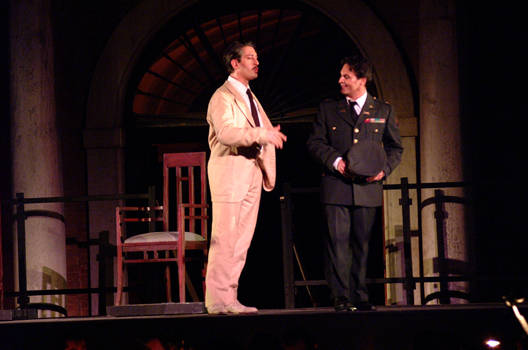
Per il Festival Pergolesi-Spontini di Jesi, nel 2003, Cristian Taraborrelli firma il suo primo debutto da regista con Lalla Rukh ovvero Guancia di tulipano, lavoro raro e poco frequentato del repertorio orientalista del primo Ottocento. Il narratore, in scena, è Aldo Busi: scrittore, traduttore, polemista letterario, una delle voci più eretiche e dotte della cultura italiana contemporanea. Dodici anni prima di La Jura al Lirico di Cagliari, Cristian si misura per la prima volta con la regia, le scene e i costumi insieme.
For the Pergolesi-Spontini Festival of Jesi, in 2003, Cristian Taraborrelli signs his first directorial debut with Lalla Rukh ovvero Guancia di tulipano, a rare and seldom-performed work from the early-nineteenth-century orientalist repertoire. The narrator, on stage, is Aldo Busi: writer, translator, literary polemicist. Twelve years before La Jura at the Lirico in Cagliari, Cristian measures himself for the first time with direction, set and costumes together.
Pour le Festival Pergolesi-Spontini de Jesi, en 2003, Cristian Taraborrelli signe son premier début de mise en scène avec Lalla Rukh ovvero Guancia di tulipano, œuvre rare du répertoire orientaliste du début du XIXe siècle. Le narrateur en scène est Aldo Busi. Douze ans avant La Jura au Lirico de Cagliari, Cristian se mesure pour la première fois à la mise en scène, aux décors et aux costumes ensemble.
L'Opera — L'Oriente immaginato dell'Ottocento
Lalla Rukh nasce come poema orientalista dell'irlandese Thomas Moore (1817), uno dei testi che più influenzeranno il romanticismo europeo nella sua passione per un Oriente immaginato — quello di Goethe, Schubert, Rimskij-Korsakov. Lalla Rukh («Guancia di tulipano»), figlia dell'imperatore moghul Aurangzeb, viaggia da Delhi a Kashmir per sposare il giovane re di Bukhara. Lungo il viaggio, il poeta Feramorz le racconta quattro storie. Quando arriva a destinazione, scopre che il re di Bukhara è Feramorz: aveva voluto conoscerla, da poeta, prima che da sposo.
Il poema diventa fonte per Spontini (Berlino 1821), Robert Schumann (cantata Das Paradies und die Peri, 1843), Anton Rubinstein (opera 1863). Per il Festival di Jesi, Cristian sceglie un registro poetico-narrativo: non un'opera ricostruita filologicamente, ma uno spettacolo-cornice in cui Aldo Busi recita-traduce dal vivo il testo, e la scenografia diventa proiezione mentale del racconto.
Lalla Rukh originates as an orientalist poem by the Irishman Thomas Moore (1817), one of the texts that most influenced European Romanticism in its passion for an imagined East. Lalla Rukh («Tulip Cheek»), daughter of the Mughal emperor Aurangzeb, travels from Delhi to Kashmir to marry the young king of Bukhara. Along the way, the poet Feramorz tells her four stories. On arrival, she discovers that the king of Bukhara is Feramorz: he had wanted to know her, as a poet, before as a husband.
The poem becomes a source for Spontini (Berlin 1821), Robert Schumann (cantata Das Paradies und die Peri, 1843), Anton Rubinstein (opera 1863). For the Jesi Festival, Cristian chooses a poetic-narrative register: not a philologically reconstructed opera, but a frame-spectacle in which Aldo Busi performs-translates the text live, and the scenography becomes a mental projection of the tale.
Lalla Rukh naît comme poème orientaliste de l'Irlandais Thomas Moore (1817). Pour le Festival de Jesi, Cristian choisit un registre poétique-narratif : un spectacle-cadre dans lequel Aldo Busi joue-traduit le texte en direct, et la scénographie devient projection mentale du récit.
La Visione — Il primo atto registico
Per Cristian, Lalla Rukh non è un esordio «timido»: è una dichiarazione di metodo. Avendo lavorato per quattro anni come scenografo e costumista del sodalizio Corsetti (dal 1999 di Maria di Rohan), ha imparato che la regia non somma elementi: li sintetizza. Cristian sceglie di firmare insieme regia, scene e costumi proprio perché i tre piani devono parlarsi come un solo organismo poetico.
Lo spazio scenico è essenziale: drappi pesanti, una piattaforma centrale per il narratore, oggetti rituali (lampade, cuscini, tappeti) che evocano il viaggio senza descrivere geograficamente l'India moghul. La scelta di Aldo Busi come narratore non è ornamentale: la sua voce — ironica, affilata, mai retorica — trasforma il poema orientalista da reperto romantico a oggetto critico contemporaneo. La sua presenza scenica frantuma l'illusione e rende lo spettacolo onestamente brechtiano.
È il primo passo di un percorso che porterà, dodici anni dopo, alla regia, scene e costumi insieme di La Jura al Teatro Lirico di Cagliari. La logica è già tutta qui: fare spettacolo come si scrive un saggio critico.
For Cristian, Lalla Rukh is not a «tentative» debut: it is a statement of method. Having worked for four years as set and costume designer in the Corsetti partnership, he has learned that direction does not add elements: it synthesises them.
The choice of Aldo Busi as narrator is not ornamental: his voice — ironic, sharp, never rhetorical — transforms the orientalist poem from a Romantic relic into a contemporary critical object. It is the first step of a path that will lead, twelve years later, to the direction, set and costumes together of La Jura.
Pour Cristian, Lalla Rukh n'est pas un début « timide » : c'est une déclaration de méthode. Premier pas d'un parcours qui mènera, douze ans plus tard, à la mise en scène, aux décors et aux costumes ensemble de La Jura.
Apparato critico
«L'Oriente non esiste. Esiste l'Europa che si guarda allo specchio e si chiama Oriente.»
«The East does not exist. What exists is Europe looking in the mirror and calling itself East.»
«L'Orient n'existe pas. Il existe l'Europe qui se regarde dans le miroir et se nomme Orient.»
Aldo Busi — intervento al Festival di Jesi, 2003
Tags
Rassegna Stampa
Materiali di rassegna stampa, recensioni e citazioni della critica disponibili su richiesta.
Press review materials, critical reviews and quotations available upon request.
Documents de revue de presse, critiques et citations disponibles sur demande.
Note di produzione
La produzione s'inscrive nell'arco trentennale del lavoro di Cristian Taraborrelli sulla scena come dispositivo cinetico, mai fondale. Materiali di scena, figurini, bozzetti, prototipi e maquette sono parte dell'archivio dello studio.
The production belongs to the thirty-year arc of Cristian Taraborrelli's work on the stage as a kinetic device, never a backdrop. Stage materials, costume sketches, prototypes and maquettes are part of the studio's archive.
La production s'inscrit dans l'arc trentenaire du travail de Cristian Taraborrelli sur la scène comme dispositif cinétique, jamais décor. Matériaux de scène, figurines, prototypes et maquettes font partie des archives de l'atelier.
Team